
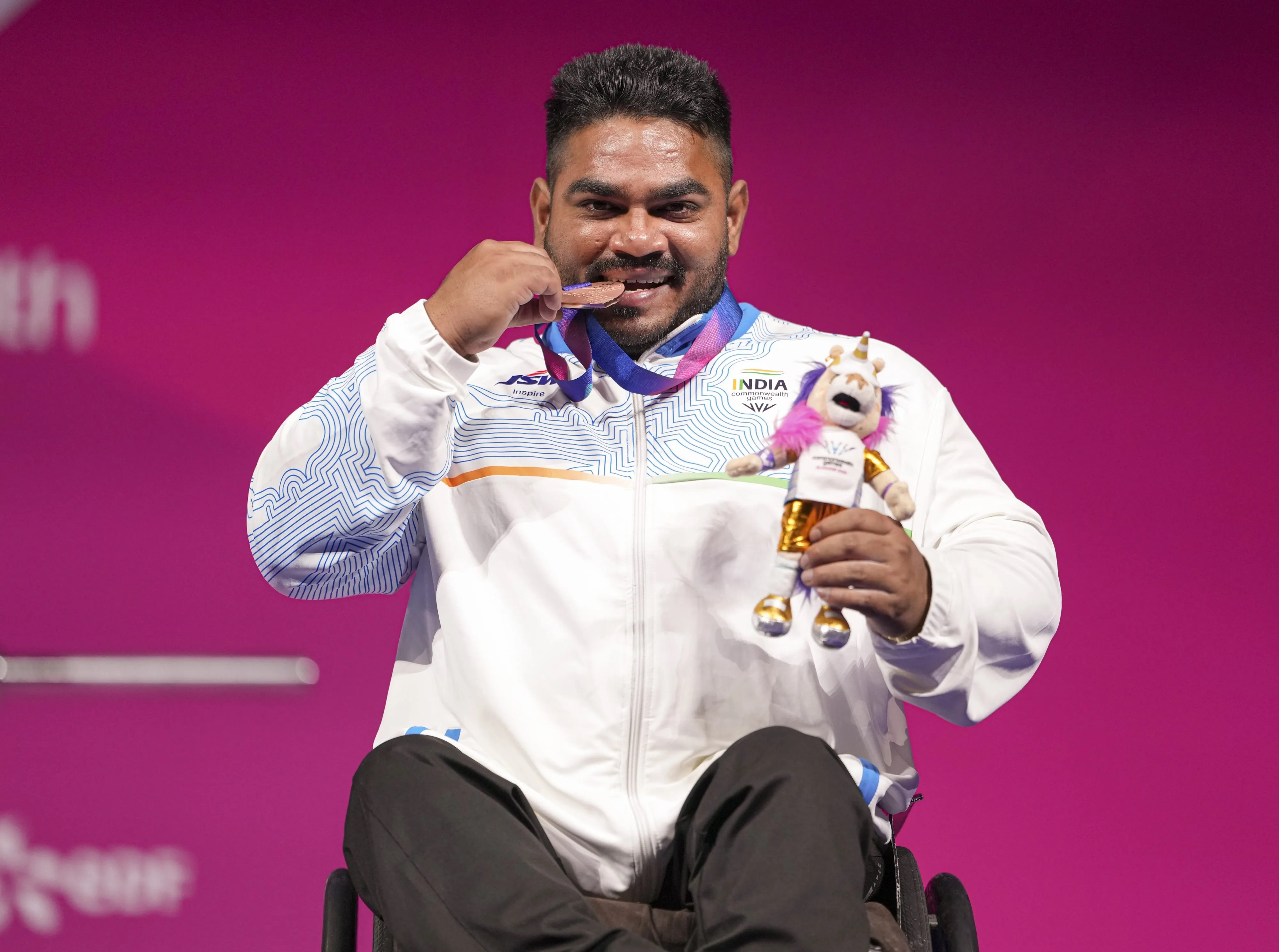
India's first medal of the Glasgow 2026 Commonwealth Games did not come from a marquee name or a marquee sport. It came from Jhandu Kumar, a para-powerlifter from Harnaut, in Bihar's Nalanda district, who took bronze in the men's heavyweight category — missing silver by a single tenth of a point.
His road there is the kind that should not be necessary. Struck by polio at five, Kumar lost the use of his legs. When the pandemic hit his family's small vegetable trade, he drove an e-rickshaw to keep the household going, training every evening after the last fare. In 2023, to fund the travel to national championships that his talent had earned, he did the only thing he could: he sold the e-rickshaw. A Paralympic medallist, coach Rajinder Singh Rahelu, saw what he had, and a place opened at the Sports Authority of India's centre in Gandhinagar — in Gujarat, the state that will host the Commonwealth Games in 2030.
It is a story to be proud of. It is also a story that reveals something uncomfortable: Kumar reached a world podium in spite of the system, not because of it. India's para talent is extraordinary and, too often, self-made — forged by hardship rather than found and built by a structure. Grit is not a development plan. It is what athletes are forced to fall back on when the plan isn't there.
This is precisely where the France–India axis stops being sentiment and becomes useful. France has just delivered Paris 2024 — the modern benchmark for a Games that treats para-sport as a headline, not an afterthought — and it has already turned that toward India. In April 2026 the French Institute in India and the Paralympic Committee of India launched Para Élan, a three-year programme carrying inclusion, resilience and equality to some 10,000 students across Indian schools. The deeper prize sits just behind it: the classification expertise, the biomechanical coaching, the adaptive training environments that France has built over decades — exactly the structure that turns an athlete like Kumar from someone who survived the system into someone it carries from day one.
At IFSA, this is the bridge we work on. Our own partnership with the Paralympic Committee of India, and the para support we extended around Paris 2024 and the 2025 World Para Athletics Championships in New Delhi, sit on the same span. And the point of a bridge is not to stand on it and admire the view — it is to move something across. India has the talent and the hunger. France has spent a generation building the method. Put them together, and the pathway that Jhandu Kumar had to build for himself becomes one the next athlete simply walks.
He got to Glasgow on his own. The work now — France and India, together — is to make sure the next one doesn't have to sell anything to get there.
Image: Jhandu Kumar celebrates his bronze medal in the men's heavyweight para powerlifting event at the Commonwealth Games, Glasgow 2026 — photograph by PTI, via The Tribune.