
On Sunday night at the OVO Hydro in Glasgow, the Commonwealth Games flag was handed to Amdavad. The centenary Games come to India in 2030 — a hundred years after Hamilton 1930, and only the second time India has hosted, after Delhi 2010.
The comparison everyone will now reach for is Paris 2024. It is the right comparison, and it is almost always drawn the wrong way.
Three numbers get quoted about Paris. Roughly ninety-five per cent of its venues were existing or temporary. Eighty-seven per cent of spectators reached the venues by public transport. Final spending came in around a quarter above the initial budget — against overruns of roughly 350 per cent at Rio 2016 and 280 per cent at Tokyo 2020. Those numbers are usually presented as achievements of the Games. They are better read as consequences of decisions taken long before them.
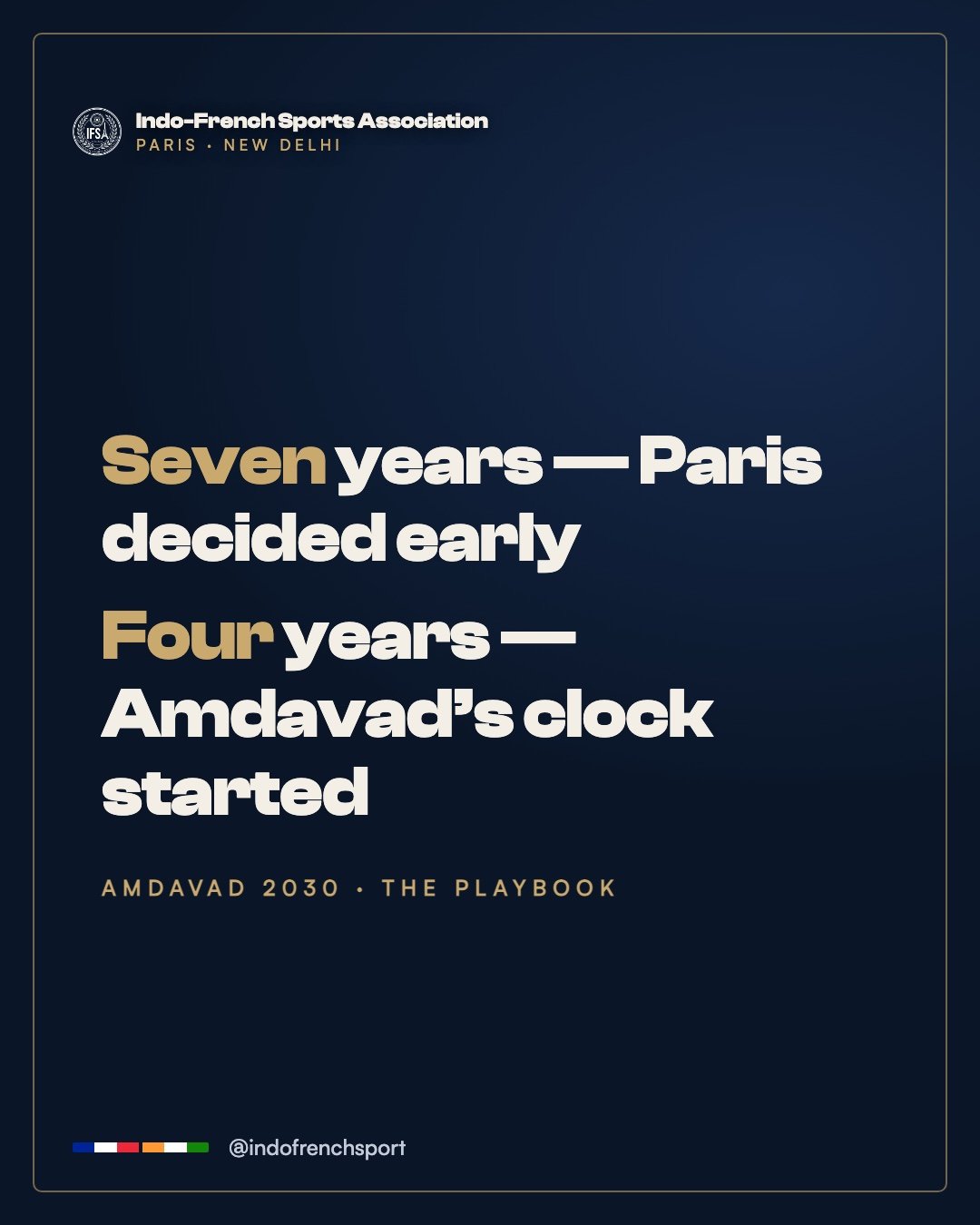
The ninety-five per cent figure was not an operational triumph delivered in the summer of 2024. It was written into Paris's bid book, published before the IOC voted in Lima in September 2017 — seven years before the opening ceremony. More than seventy per cent existing facilities, a further twenty-five per cent temporary: that was the shape of the Games before a single contract was signed. By the time the world admired the venue policy, the venue policy was nearly a decade old.
That is the transferable lesson, and it is a lesson about timing rather than architecture.
Amdavad has four years and a few months. Paris, at the equivalent point in its own cycle, had already locked what kind of Games it intended to be. So the useful question is not what India can copy from Paris. It is which decisions have to be taken in the next eighteen months — the venue and temporary-build policy, the public-transport commitment, the workforce and volunteer model, the named post-Games use of every permanent structure — because those are precisely the decisions that cannot be revisited in 2029.
The bridge to do this on is already open. In January 2024, the two governments put sport into the bilateral relationship: the joint statement issued during President Macron's state visit committed to facilitating Indian sporting delegations in French training facilities, and France offered to share its Paris 2024 experience with India. In July 2026, FICCI's Sports Committee and Business France took more than twenty representatives of India's sports ecosystem through Paris and Marseille — the Stade de France, the Vélodrome, the RIGES forum — with a white paper on French Olympic legacy to follow.
Our reservation is not with the traffic. It is with the form.
A delegation is an event. Transfer is a habit. What actually moves know-how between two sporting systems is people embedded long enough to become bored: a coach through a full season, an operations officer through a full build cycle, a classifier through a full competition. We know the difference at our own modest scale. Our strongest result to date is not an announcement but a delivery — a twenty-day under-18 camp run in Lyon for players sent by the Government of Meghalaya, from which four were scouted. Twenty days did more than twenty meetings would have.
So our suggestion to those who will carry Amdavad is a small and unglamorous one: name the counterpart. One standing France–India transfer channel, with a named owner on each side and a mandate that outlives any single delegation or ministerial term. Delegations can then feed it instead of substituting for it.
We are not building the Commonwealth Games. We are building the same mechanism at a smaller size, and we started early. A letter of intent signed with France's Ligue Nationale de Basket in April 2026 opens professional French basketball environments to Indian talent. A student-athlete route with LOSC Lille and the Université de Lille pairs a serious football environment with a serious classroom. The third Indo-French Football Tournament comes to India from 26 October to 1 November — the first edition on Indian soil.
France just did this. India is next. The part worth copying is not what Paris built. It is when Paris decided.