
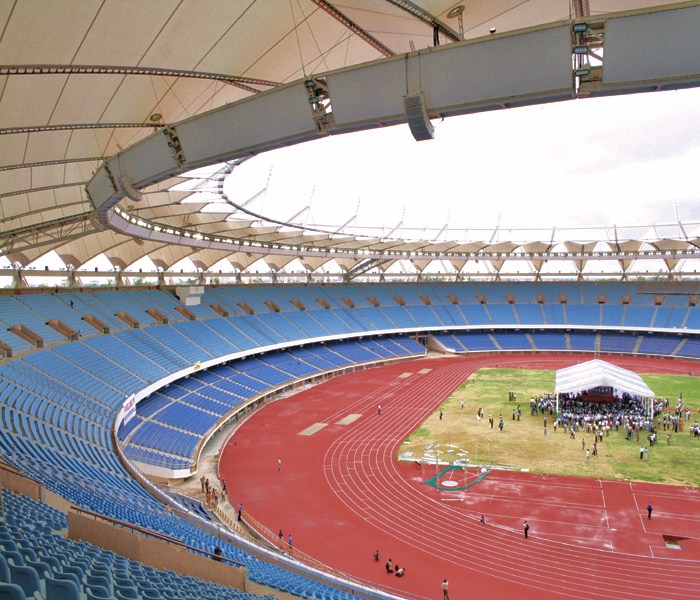
Twelve days before the Delhi 2010 Commonwealth Games opened, the president of the Commonwealth Games Federation said the athletes' village was "seriously compromised" and demanded immediate government action. New Zealand, Canada, Scotland and Ireland called their assigned accommodation unliveable. Advance parties reported dirty rooms, broken plumbing, exposed wiring. Eight days before the opening ceremony, a footbridge under construction near Jawaharlal Nehru Stadium — the Games' centrepiece venue — collapsed, injuring more than 20 construction workers.
The Games opened anyway, on 3 October 2010, and ran their course. But the Comptroller and Auditor General's subsequent 743-page report documented corruption, mismanagement and favouritism across nearly every stage of preparation, and the organising committee's chairman was later investigated over the award of contracts. Estimates of the final cost vary — from roughly $7.5 billion to figures several times that — against an original bid budget in the low hundreds of millions. Whatever the true number, it is not disputed that Delhi 2010 became the most expensive Commonwealth Games ever held, for outcomes that embarrassed rather than showcased the country.
That is the record. It is not a reason to fear Amdavad 2030 — it is the reason Amdavad 2030 has to be planned differently, on purpose, from the start.
Three failures at Delhi are worth naming precisely, because each one has a specific, knowable fix.
The venue-readiness failure was a sequencing failure. Construction ran to the deadline instead of well ahead of it, which meant there was no slack left when problems surfaced — a collapsed bridge with eight days to go is not a delay, it is a crisis with no room to absorb it. Paris 2024, by contrast, had its permanent venues substantially complete more than a year out, precisely so that the final months were for testing and refinement, not construction. Amdavad's organisers have a full four years from now; the discipline is choosing to front-load irreversible builds — venues, transport, permanent infrastructure — into 2026 and 2027, not 2029.
The accountability failure was a transparency failure. The CAG report that exposed Delhi's corruption came after the Games, when the damage was already done and the money already spent. An open, audited procurement process, with findings published as the Games are built rather than after they close, is not a cosmetic add-on — it is the difference between a scandal discovered in year six and one prevented in year two.
The legacy failure was a design failure. Delhi's Games-time infrastructure was built to open on time, not to be used for the following decade — several venues fell into disrepair within a few years of the closing ceremony. Amdavad's organisers have the chance to ask a different question at every design decision from the outset: not "will this be ready for opening night," but "what does this become on 1 November 2030, the day after the Games end."
We say this from inside the exact bridge Amdavad can draw on. Paris 2024 delivered a Games built on the discipline Delhi lacked — front-loaded construction, published accountability, venues designed for permanent post-Games use, from the Olympic Village housing developments to the Seine clean-up that outlasted the closing ceremony. IFSA sits between the country that just hosted well and the country about to host again, and the honest version of that role is not applause — it is naming, plainly, what has to be different this time, while there is still time to make it different.
Image: Jawaharlal Nehru Stadium, Delhi, July 2010 — photograph by Bhaumik J, CC BY 3.0, via Wikimedia Commons.