

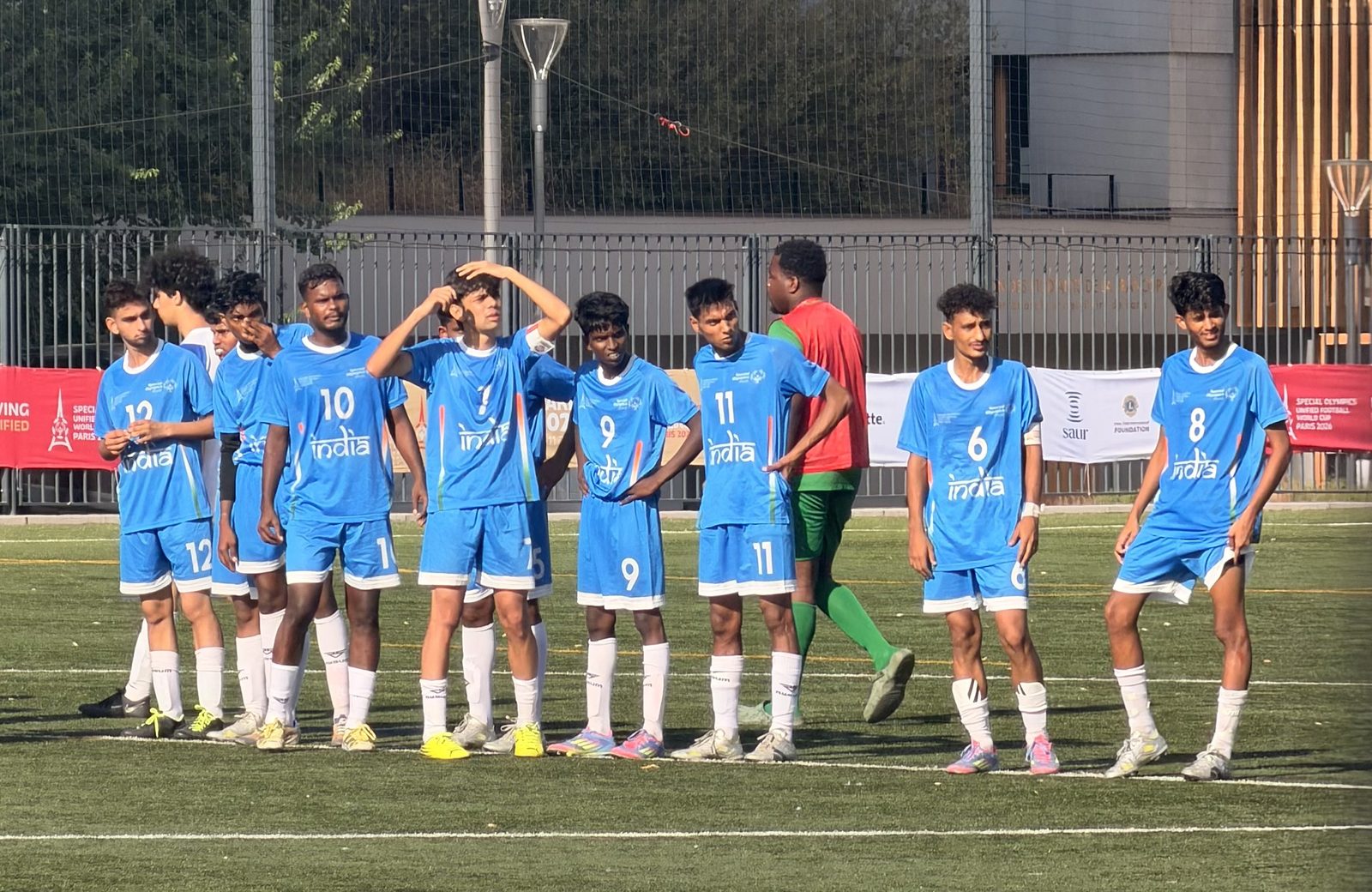
On 11 July 2026, under the lights at the Stade Charléty in Paris, a team wearing India’s blue stood on a World Cup podium. Special Olympics Bharat — India’s Unified team — had taken silver at the Special Olympics Unified Football World Cup, beaten only by Spain, 1–0, in the Division 3 final.
They finished the tournament ranked second in their division — above France, the host nation, who took the bronze. A team from India, on French soil, standing a step higher than France on the podium.
What made it remarkable was not only the result but the form of the game itself. Unified Football puts athletes with and without intellectual disabilities on the same team, playing as equals, judged on the same pitch by the same rules. It is football stripped back to its first principle: that the game belongs to anyone who can play it. To reach a world final in that format, representing India, is an achievement that stands entirely on its own.
The squad, led by captain Azeem Tariq, arrived in Paris among 24 nations and left with a silver medal. They played strong opponents, held their nerve through the knockout rounds, and lost the final by a single goal to the eventual champions. Every player who pulled on that shirt carried the tricolour onto one of the biggest stages their sport offers — and brought it home with silver.
It is worth pausing on that, simply and without qualification: a team of Indian athletes went to Paris and came back second in the world. They earned the spotlight. This is a moment to give it to them.